This aircraft, weighing more than 200 tons, without any engine, on the dark Atlantic Ocean, was just a glider. A deep sea thousands of feet below, the darkness of the night above, and no runway to land nearby. Until this day, there was no recorded case of a fuel leak depleting all the fuel in commercial aviation. There was no pilot who had dealt with such a situation. No training manual, no checklist, no precedent. There was nothing to tell the pilots what to do next.
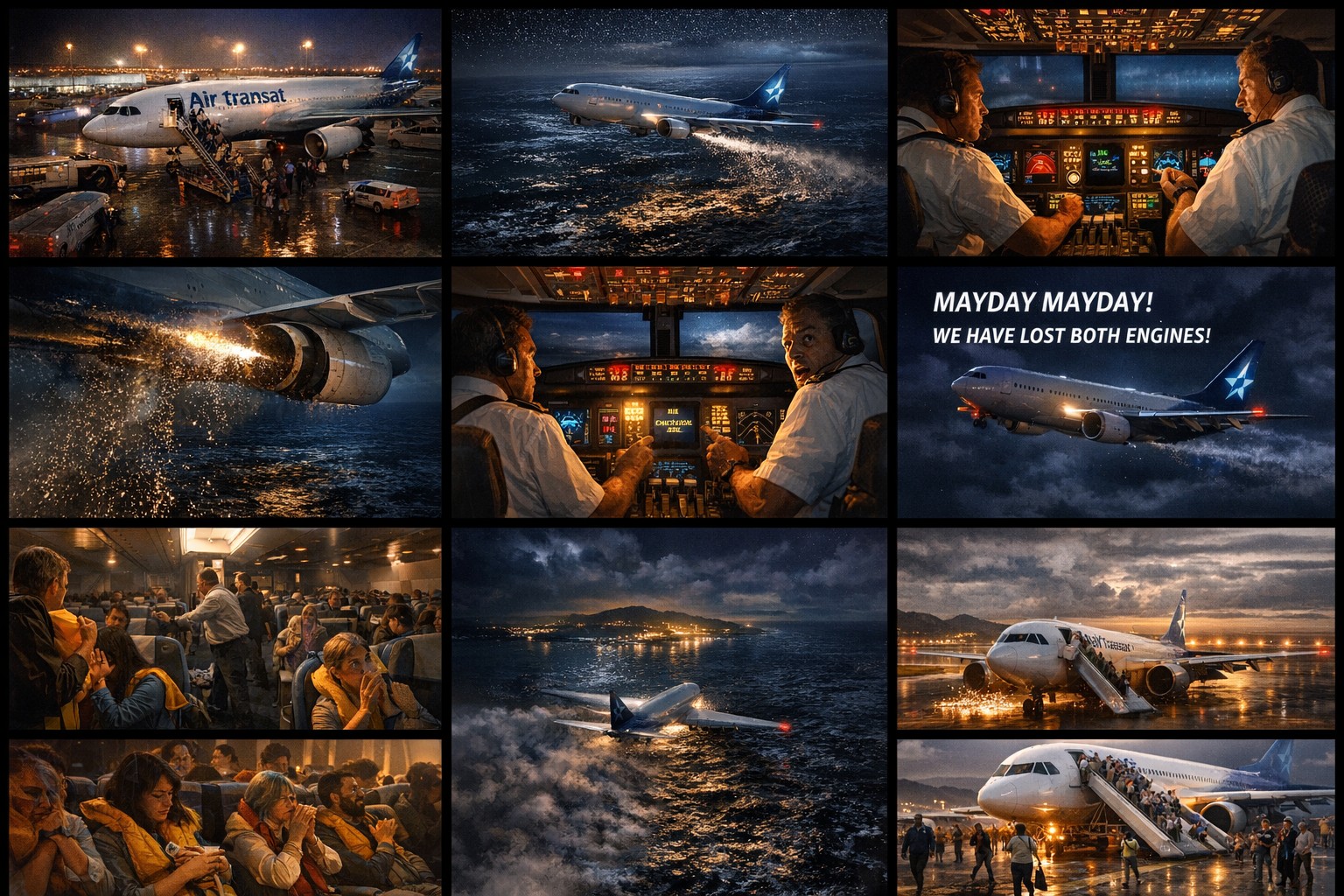
Hello! August 23rd, 2001. It was around 11 PM.
Toronto Pearson International Airport was in a mess. In the summer, there was a huge crowd at the gates. Families with excited children, romantic couples holding hands, students returning home, everyone was boarding from different gates for their flights. And at one of these busy gates, Air Transat, a Canadian airline's flight TSC 236, was parked. It was a regular overnight flight from Toronto to Portugal. There were 293 passengers and 13 crew members. That means a total of 306 souls on board. Most of the passengers were Canadians of Portuguese origin. They were happily going to Portugal to enjoy their summer vacation with relatives and friends, full of laughter and anticipation.
On August 24th, at 12:52 AM, the flight took off from Toronto. “240 at 8, cleared for takeoff. 24R, Transat 236 Heavy.” It had to cross the entire vast Atlantic Ocean to reach Lisbon, Portugal. A few minutes after takeoff, the plane smoothly reaches a height of 39,000 feet and continues its long journey across the night sky. The passengers had their dinner, some watched in-flight movies, the kids slowly went to sleep, and the cabin lights were dimmed for comfort. Just like any normal transatlantic flight, this aircraft was passing peacefully over the dark Atlantic Ocean.
Everything seemed perfectly normal on the surface, but deep inside the cockpit something dangerous was happening that would soon make this flight one of the most terrifying and dangerous incidents in the entire history of aviation. The people sitting comfortably in their seats did not know at all that a silent time bomb was ticking away. All the fuel in this massive plane was about to run out completely over the middle of the ocean, and both its powerful engines were about to shut down one after another. On top of that, the flight was commanded by a pilot who was once charged with drug smuggling many years ago. He had been sentenced to several years in prison. But absolutely no one on the plane knew about this hidden part of his past.
This whole nightmare started about 9 days earlier. In a matter of just a few millimeters, the fate of this aircraft and everyone on board was quietly being written. On August 15th, 2001, the maintenance team of Air Transat, during a routine inspection of the plane, found small metal chips in the oil system of its right engine. It was a very serious warning sign that something was seriously wrong inside the engine. Just 2 days later, on August 17th, they found more metal particles again. The airline now had no other option left. It was clear that the damaged engine would have to be replaced immediately. But the big problem was that Air Transat didn't have any spare engines available in their inventory at that moment.
So they decided to take an engine on loan from Rolls-Royce. And this is exactly where the real trouble began to take shape. Imagine that your phone's charger is damaged, and you borrow a similar-looking charger that appears identical from the outside, but the internal wiring and design is actually different. In that case, your charger may work for a few days, but eventually it will short-circuit and cause bigger problems. This is precisely what happened with this aircraft. The new replacement engine from Rolls-Royce was of an older design. The rest of the plane's systems were based on a newer design. Everything looked exactly the same from the outside, but the fitting and positioning of the fuel and hydraulic tubes inside were slightly different. And when the borrowed engine arrived, the inspection team unfortunately didn't notice this critical difference.
The engine change work started urgently at midnight on August 17th. It was necessary to complete the entire job by Sunday afternoon because the plane had a scheduled flight after that. This put the mechanics under tremendous time pressure. As soon as the mechanics began the engine replacement, an unexpected problem appeared. The hydraulic pump of the plane wasn't fitting properly on the new engine because a fuel tube was blocking the way. The lead technician quickly searched the parts list for the Airbus, and he discovered that the fuel and hydraulic tubes on this particular engine were different from the other systems already installed on the plane. He couldn't immediately figure out the correct way to fit the old-style engine with the new pump.
He tried to open the official Rolls-Royce manual on three different computers in the hangar, but the network was down and the files wouldn't open. But here comes the most shocking and unfortunate part of the whole story. The complete service bulletin manual was actually available right there on offline CDs stored in the same building. Yet our lead technician had no idea that those CDs even existed. The important document on which the lives of hundreds of people would soon depend was physically present in the facility, but in the rush no one bothered to search for it or use it. The time pressure was extremely high. The plane absolutely had to be ready by Sunday afternoon. So the technician, under stress, decided to take a dangerous shortcut. He installed new fuel tubes on the engine, but left the hydraulic tube in the old design. As a result, on one single engine there were now two tubes of completely different designs that were never meant to work together.
It was clearly mentioned and warned in the Rolls-Royce service bulletin that the fuel tube and hydraulic tube must always be changed together as a complete set. But because of the network failure, unfortunately no one had read this important service bulletin. When the hydraulic system was later pressurized for testing, the hydraulic line's flange started to rotate slightly and moved closer to the fuel line. Two metal tubes that should never have touched each other under any circumstances now began to rub against one another with every vibration of the engine. But no one noticed this hidden danger during the rushed inspection. After the installation was finally complete, everything appeared normal from the outside. There was no visible leak and no warning lights came on. That is why the plane was cleared and released for regular flight operations.
After the engine was changed, the plane successfully flew several flights without anyone suspecting that a deadly ticking time bomb was installed inside it. Due to constant vibration and hydraulic pressure during those flights, the two mismatched tubes kept coming closer and rubbing against each other more and more. Slowly and silently, the wall of the fuel tube was being worn down thinner and thinner. It was now only a matter of time before the tube would completely crack and break open.
Let's go back to the night of August 24th. Flight 236 was cruising peacefully high over the dark Atlantic Ocean. Everything still looked completely normal to the crew and passengers. A total of 46.9 metric tons of fuel had been loaded for the flight, which was actually 5.5 metric tons more than the minimum fuel required for the journey. But at exactly 4:38 AM, the flight data recorder quietly noted that the fuel quantity was now decreasing at a rapid and alarming rate. Due to the continuous friction between the hydraulic line and the fuel line over several hours of flight, a dangerous L-shaped crack had finally formed on the thin wall of the fuel tube. Fuel had now started leaking out rapidly. But strangely, neither did any alarm ring loudly in the cockpit, nor did any warning lights illuminate on the instrument panel. The main reason for this was that at that time the Airbus A330 did not have any direct sensor installed to detect a fuel leak in the system. Gradually the crack grew bigger under pressure, and the fuel began leaking even faster. The leak rate soon reached a shocking 13 metric tons per hour.
None of the 306 people on board the aircraft had any idea that hundreds of kilograms of their precious fuel were silently pouring out into the cold Atlantic Ocean below. It was only at 5:03 AM that the crew first noticed some unusual oil temperature and pressure readings appearing for the right engine. They realized fuel was somehow leaking from that side. But the pilots were confused and wondered why this was happening. At first they thought it might just be a computer glitch or faulty sensor. Then at 5:33 AM, about four hours and forty minutes after takeoff, an advisory message finally flashed on the cockpit screen. The crew now saw that the fuel balance between the left and right wing tanks had become badly uneven. The right side now had much less fuel compared to the left side.
This is how a fuel imbalance situation normally occurs in modern aircraft. There is a standard written procedure to fix it. You are supposed to take out the official checklist and carefully follow every step one by one. The crew thought this was not a very big issue and they could handle it quickly. But here they made another serious mistake — in fact, the biggest and most costly mistake of the entire incident, which would soon turn a manageable problem into a complete disaster. Instead of following the official checklist properly, the crew tried to fix the fuel imbalance from their memory alone. It was clearly written and highlighted in the checklist that if there was even the slightest doubt of a possible fuel leak, then pilots must immediately follow the dedicated “fuel leak”














The Terrifying Story of Flight 236
* กระทู้นี้สามารถใช้งานได้เฉพาะผู้ที่มี Link นี้เท่านั้นค่ะHello! August 23rd, 2001. It was around 11 PM.
Toronto Pearson International Airport was in a mess. In the summer, there was a huge crowd at the gates. Families with excited children, romantic couples holding hands, students returning home, everyone was boarding from different gates for their flights. And at one of these busy gates, Air Transat, a Canadian airline's flight TSC 236, was parked. It was a regular overnight flight from Toronto to Portugal. There were 293 passengers and 13 crew members. That means a total of 306 souls on board. Most of the passengers were Canadians of Portuguese origin. They were happily going to Portugal to enjoy their summer vacation with relatives and friends, full of laughter and anticipation.
On August 24th, at 12:52 AM, the flight took off from Toronto. “240 at 8, cleared for takeoff. 24R, Transat 236 Heavy.” It had to cross the entire vast Atlantic Ocean to reach Lisbon, Portugal. A few minutes after takeoff, the plane smoothly reaches a height of 39,000 feet and continues its long journey across the night sky. The passengers had their dinner, some watched in-flight movies, the kids slowly went to sleep, and the cabin lights were dimmed for comfort. Just like any normal transatlantic flight, this aircraft was passing peacefully over the dark Atlantic Ocean.
Everything seemed perfectly normal on the surface, but deep inside the cockpit something dangerous was happening that would soon make this flight one of the most terrifying and dangerous incidents in the entire history of aviation. The people sitting comfortably in their seats did not know at all that a silent time bomb was ticking away. All the fuel in this massive plane was about to run out completely over the middle of the ocean, and both its powerful engines were about to shut down one after another. On top of that, the flight was commanded by a pilot who was once charged with drug smuggling many years ago. He had been sentenced to several years in prison. But absolutely no one on the plane knew about this hidden part of his past.
This whole nightmare started about 9 days earlier. In a matter of just a few millimeters, the fate of this aircraft and everyone on board was quietly being written. On August 15th, 2001, the maintenance team of Air Transat, during a routine inspection of the plane, found small metal chips in the oil system of its right engine. It was a very serious warning sign that something was seriously wrong inside the engine. Just 2 days later, on August 17th, they found more metal particles again. The airline now had no other option left. It was clear that the damaged engine would have to be replaced immediately. But the big problem was that Air Transat didn't have any spare engines available in their inventory at that moment.
So they decided to take an engine on loan from Rolls-Royce. And this is exactly where the real trouble began to take shape. Imagine that your phone's charger is damaged, and you borrow a similar-looking charger that appears identical from the outside, but the internal wiring and design is actually different. In that case, your charger may work for a few days, but eventually it will short-circuit and cause bigger problems. This is precisely what happened with this aircraft. The new replacement engine from Rolls-Royce was of an older design. The rest of the plane's systems were based on a newer design. Everything looked exactly the same from the outside, but the fitting and positioning of the fuel and hydraulic tubes inside were slightly different. And when the borrowed engine arrived, the inspection team unfortunately didn't notice this critical difference.
The engine change work started urgently at midnight on August 17th. It was necessary to complete the entire job by Sunday afternoon because the plane had a scheduled flight after that. This put the mechanics under tremendous time pressure. As soon as the mechanics began the engine replacement, an unexpected problem appeared. The hydraulic pump of the plane wasn't fitting properly on the new engine because a fuel tube was blocking the way. The lead technician quickly searched the parts list for the Airbus, and he discovered that the fuel and hydraulic tubes on this particular engine were different from the other systems already installed on the plane. He couldn't immediately figure out the correct way to fit the old-style engine with the new pump.
He tried to open the official Rolls-Royce manual on three different computers in the hangar, but the network was down and the files wouldn't open. But here comes the most shocking and unfortunate part of the whole story. The complete service bulletin manual was actually available right there on offline CDs stored in the same building. Yet our lead technician had no idea that those CDs even existed. The important document on which the lives of hundreds of people would soon depend was physically present in the facility, but in the rush no one bothered to search for it or use it. The time pressure was extremely high. The plane absolutely had to be ready by Sunday afternoon. So the technician, under stress, decided to take a dangerous shortcut. He installed new fuel tubes on the engine, but left the hydraulic tube in the old design. As a result, on one single engine there were now two tubes of completely different designs that were never meant to work together.
It was clearly mentioned and warned in the Rolls-Royce service bulletin that the fuel tube and hydraulic tube must always be changed together as a complete set. But because of the network failure, unfortunately no one had read this important service bulletin. When the hydraulic system was later pressurized for testing, the hydraulic line's flange started to rotate slightly and moved closer to the fuel line. Two metal tubes that should never have touched each other under any circumstances now began to rub against one another with every vibration of the engine. But no one noticed this hidden danger during the rushed inspection. After the installation was finally complete, everything appeared normal from the outside. There was no visible leak and no warning lights came on. That is why the plane was cleared and released for regular flight operations.
After the engine was changed, the plane successfully flew several flights without anyone suspecting that a deadly ticking time bomb was installed inside it. Due to constant vibration and hydraulic pressure during those flights, the two mismatched tubes kept coming closer and rubbing against each other more and more. Slowly and silently, the wall of the fuel tube was being worn down thinner and thinner. It was now only a matter of time before the tube would completely crack and break open.
Let's go back to the night of August 24th. Flight 236 was cruising peacefully high over the dark Atlantic Ocean. Everything still looked completely normal to the crew and passengers. A total of 46.9 metric tons of fuel had been loaded for the flight, which was actually 5.5 metric tons more than the minimum fuel required for the journey. But at exactly 4:38 AM, the flight data recorder quietly noted that the fuel quantity was now decreasing at a rapid and alarming rate. Due to the continuous friction between the hydraulic line and the fuel line over several hours of flight, a dangerous L-shaped crack had finally formed on the thin wall of the fuel tube. Fuel had now started leaking out rapidly. But strangely, neither did any alarm ring loudly in the cockpit, nor did any warning lights illuminate on the instrument panel. The main reason for this was that at that time the Airbus A330 did not have any direct sensor installed to detect a fuel leak in the system. Gradually the crack grew bigger under pressure, and the fuel began leaking even faster. The leak rate soon reached a shocking 13 metric tons per hour.
None of the 306 people on board the aircraft had any idea that hundreds of kilograms of their precious fuel were silently pouring out into the cold Atlantic Ocean below. It was only at 5:03 AM that the crew first noticed some unusual oil temperature and pressure readings appearing for the right engine. They realized fuel was somehow leaking from that side. But the pilots were confused and wondered why this was happening. At first they thought it might just be a computer glitch or faulty sensor. Then at 5:33 AM, about four hours and forty minutes after takeoff, an advisory message finally flashed on the cockpit screen. The crew now saw that the fuel balance between the left and right wing tanks had become badly uneven. The right side now had much less fuel compared to the left side.
This is how a fuel imbalance situation normally occurs in modern aircraft. There is a standard written procedure to fix it. You are supposed to take out the official checklist and carefully follow every step one by one. The crew thought this was not a very big issue and they could handle it quickly. But here they made another serious mistake — in fact, the biggest and most costly mistake of the entire incident, which would soon turn a manageable problem into a complete disaster. Instead of following the official checklist properly, the crew tried to fix the fuel imbalance from their memory alone. It was clearly written and highlighted in the checklist that if there was even the slightest doubt of a possible fuel leak, then pilots must immediately follow the dedicated “fuel leak”