BANGKOK — The Democrat Party has seen the enemy.
The Democrats, whose veterans are at the forefront of the anti-government protests that have shaken Bangkok for the past six weeks, say the enemy is a brutal system that has allowed their political nemesis to remain politically powerful, even from far away in Dubai, in exile. The system has driven them to launch angry protests that have left at least five people dead and littered a few streets with the carcasses of burned-out police trucks. It has kept the party from winning a national election for two decades.
The enemy of the Democrat Party? It’s democracy.
Or as protest leader Suthep Thaugsuban calls it, “the tyranny of the parliamentary majority.”
When Thailand’s elected prime minister refused an opposition demand to step aside, Suthep’s answer this week was to effectively declare a new government, in the form of a self-appointed “People’s Democratic Reform Committee.” He ordered civil servants to answer to the committee, called for a shadow system of volunteers to replace the police and issued an order that Prime Minister Yingluck Shinawatra be prosecuted for insurrection.
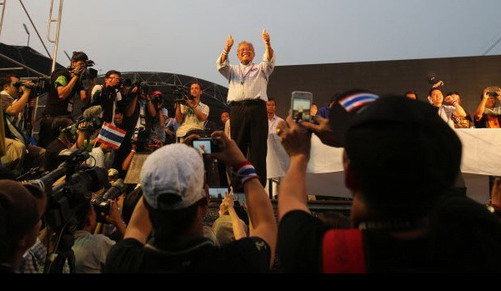
“Today will be a historic day,” Suthep roared Monday to tens of thousands of protesters crowding streets around the prime minister’s office. Suthep was a Democrat Party leader until he symbolically resigned shortly before the protests began, though he remains strongly identified with the party.
“This will be the first time that the people, the owners of the country, stood up to take back their sovereign power.”
On Wednesday, most civil servants appeared to defy Suthep’s order to report to the Reform Committee, but the move represents an uncertain and potentially dangerous division in Thai politics, which has been convulsed by repeated, often-violent protests since a 2006 coup ousted Prime Minister Thaksin Shinawatra, Yingluck’s brother.
The coup exposed a deep division in Thai society. Thaksin’s supporters are mostly poor, rural people from the country’s north and northeast, drawn to him by government programs he created offering everything from nearly free medical care to guaranteed crop prices.
The traditional elite, meanwhile — high-level civil servants and military officers, aristocrats, professionals and businessmen — remain with the Democrat Party.
http://www.washingtonpost.com/world/asia_pacific/looking-for-democracy-in-thailands-democrat-party/2013/12/11/f03bebc2-6256-11e3-af0d-4bb80d704888_story.html














*****วอชิงตันโพสต์ ได้รายงานข่าวในไทยว่า "ศัตรูของพรรคประชาธิปัตย์คือ ประชาธิปไตย"*****
BANGKOK — The Democrat Party has seen the enemy.
The Democrats, whose veterans are at the forefront of the anti-government protests that have shaken Bangkok for the past six weeks, say the enemy is a brutal system that has allowed their political nemesis to remain politically powerful, even from far away in Dubai, in exile. The system has driven them to launch angry protests that have left at least five people dead and littered a few streets with the carcasses of burned-out police trucks. It has kept the party from winning a national election for two decades.
The enemy of the Democrat Party? It’s democracy.
Or as protest leader Suthep Thaugsuban calls it, “the tyranny of the parliamentary majority.”
When Thailand’s elected prime minister refused an opposition demand to step aside, Suthep’s answer this week was to effectively declare a new government, in the form of a self-appointed “People’s Democratic Reform Committee.” He ordered civil servants to answer to the committee, called for a shadow system of volunteers to replace the police and issued an order that Prime Minister Yingluck Shinawatra be prosecuted for insurrection.
“Today will be a historic day,” Suthep roared Monday to tens of thousands of protesters crowding streets around the prime minister’s office. Suthep was a Democrat Party leader until he symbolically resigned shortly before the protests began, though he remains strongly identified with the party.
“This will be the first time that the people, the owners of the country, stood up to take back their sovereign power.”
On Wednesday, most civil servants appeared to defy Suthep’s order to report to the Reform Committee, but the move represents an uncertain and potentially dangerous division in Thai politics, which has been convulsed by repeated, often-violent protests since a 2006 coup ousted Prime Minister Thaksin Shinawatra, Yingluck’s brother.
The coup exposed a deep division in Thai society. Thaksin’s supporters are mostly poor, rural people from the country’s north and northeast, drawn to him by government programs he created offering everything from nearly free medical care to guaranteed crop prices.
The traditional elite, meanwhile — high-level civil servants and military officers, aristocrats, professionals and businessmen — remain with the Democrat Party.
http://www.washingtonpost.com/world/asia_pacific/looking-for-democracy-in-thailands-democrat-party/2013/12/11/f03bebc2-6256-11e3-af0d-4bb80d704888_story.html